In the fast-paced world of dentistry, where every procedure demands reliability and finesse, the dental micromotor remains a vital component for handling low-speed tasks like restorative work and lab finishing. Clinicians often grapple with whether to stick with time-tested air-driven models or invest in cutting-edge electric ones—a decision that influences not just daily efficiency but also patient satisfaction and operational expenses over years.
Drawing from recent industry insights, this guide offers a balanced, evidence-based comparison to empower your choice, focusing on real clinical demands and emerging trends.
Part I: The Core Showdown: Electric vs. Air
At their heart, electric and air-driven dental micromotors diverge in power delivery and design, shaping everything from procedure quality to practitioner comfort.
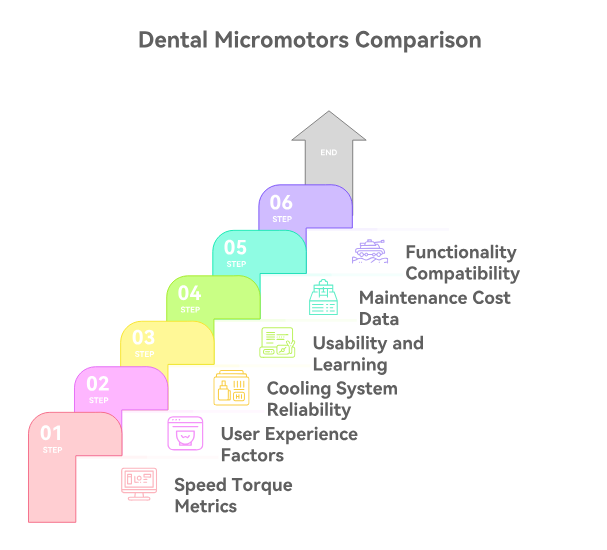
1.Core Performance: Torque and Speed Control
- Electric models shine with unwavering torque that maintains steady speeds—even under resistance from dense materials like enamel—spanning 100 to 40,000 RPM for unmatched control in intricate tasks like implant prep.
- Air-driven units, powered by turbine spin-up to 400,000 RPM unloaded, falter when torque drops sharply on contact, leading to inconsistent cuts that demand more passes.
2.User Experience: Noise, Vibration, and Ergonomics
- Electric micromotors operate with subdued hums and minimal shake, fostering calmer sessions that ease patient jitters and spare your hands during marathon procedures; their slightly bulkier build from integrated components is offset by ergonomic gains.
- In contrast, air-driven options deliver that signature high-pitched whine and buzz, though their featherweight design feels intuitive for veterans of traditional setups.
3.Cooling and Spray Systems
- Integrated sprays in electric systems ensure reliable, even coolant flow, safeguarding pulp during endodontic work and minimizing debris scatter for safer, cleaner ops.
- Air-driven cooling hinges on compressor stability, where pressure dips can disrupt flow and heighten overheating risks.
4.Usability and Learning Curve
- Electric interfaces allow preset profiles for speed and torque, streamlining workflows with predictable results and less mental overhead—ideal for mixed teams.
- Air-driven reliance on pedal finesse and auditory cues builds skill over time but can amplify focus demands in high-volume practices.
5.Long-Term Value: Cost, Maintenance, and Durability
| Cost Factor |
Electric Micromotor |
Air-Driven Micromotor |
| Initial Investment |
Steeper entry due to motor and console needs, but offsets with longevity. |
Affordable startup, leveraging existing air infrastructure. |
| Durability & Maintenance |
Fewer wear points in brushless designs yield lower ongoing costs, around $300 less annually. |
Prone to turbine erosion and lubrication needs, hiking repair frequency. |
6.Functionality and Compatibility
- Electric versatility extends to seamless LED integration and bidirectional rotation, independent of air variability for consistent output.
- Air-driven basics tie performance to compressor quality, limiting adaptability in variable setups.
Part II: Application-Specific Decision Guide
Align your micromotor with routine cases for optimal returns.
| Application Scenario |
Recommended Type |
Key Reasons (User Benefits) |
| A. Clinical Restoration (Prep & Finishing) |
Electric |
Constant power yields precise margins, cutting prep time and boosting fit accuracy. |
| B. Implant & Surgery |
Electric |
Superior low-speed torque ($<20,000$ RPM) enables controlled depth without stalls. |
| C. Heavy Duty Laboratory Work |
Brushless Electric |
Endures prolonged grinding on alloys and zirconia with minimal heat buildup. |
| D. Patient Experience Prioritized |
Electric |
Quieter runs and less vibration dial back anxiety, enhancing retention. |
| E. Basic Operations/Budget Constraints |
Air-Driven |
Economical for routine cleanings or backups without precision premiums. |
Part III: Maintenance and Future Trends
Sustain peak performance while eyeing innovations that future-proof your setup.
Key Maintenance Points for Improving Lifespan
- Lubrication: Air units crave regular turbine oils; electrics, particularly brushless, demand far less, streamlining routines.
- Disinfection and Sterilization: Heed protocols to shield electric internals from autoclave wear—often costlier than air turbine swaps.
- Cleaning: Flush lines routinely to avert clogs in both, preserving flow.
- Air Compressor Management: Vital for air models—filter out moisture to sidestep turbine failures.
Industry Trend: The Rise of Brushless Electric Motors
Brushless electrics are taking over as the go-to, ditching old carbon brushes for longer runs, cooler temps, and sharper power delivery. They're proofing practices against tomorrow's demands, with 2025 seeing wider adoption in clinics chasing precision and uptime.
Conclusion and Final Recommendation
The "ideal" dental micromotor hinges on your practice's rhythm: electric for precision-driven growth, air-driven for straightforward affordability. Prioritize torque for surgery or quiet for comfort, and you'll amplify efficiency while curbing regrets.
Check out RHJC's site for a full lineup of dental micromotors and add-ons tailored to real practices.