Your Micromotor system—comprising a control box and a handpiece—is your workstation's heartbeat. As the high-frequency operating end, the handpiece is the most vulnerable component.
Proper maintenance prevents costly repairs and ensures "zero vibration." This precision is vital for professional nail art, dentistry, and jewelry craftsmanship.
I. The Invisible Killer – Dust and Debris
Nail dust, dental particles, or jewelry shavings are highly abrasive. They act like sandpaper once inside. When they enter the internal bearings, they wear down the steel balls. This leads to overheating, power loss, and abnormal noise.
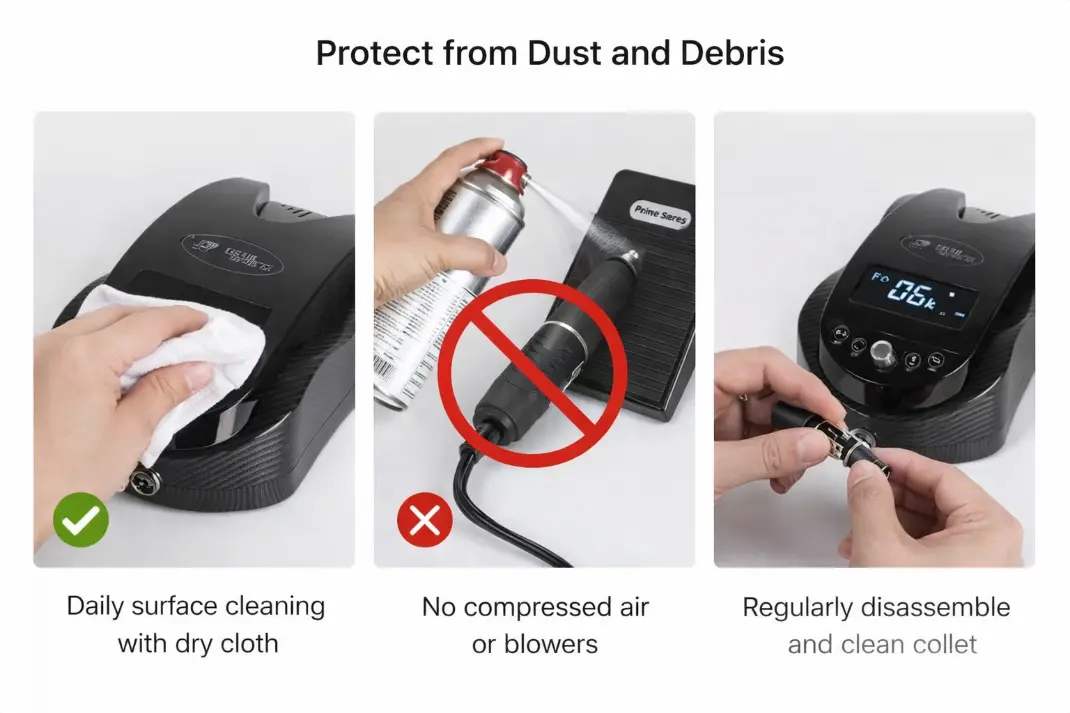
Dust can ruin a motor.
Action Guidelines:
- Daily Surface Cleaning: Only use a dry, soft cloth. Wipe the handpiece thoroughly after every session.
- The Strict Prohibition: Never use compressed air or dust blowers. The instantaneous high pressure forces dust deep into the sealed bearings. This causes immediate internal scarring.
- Advanced Maintenance: Regularly disassemble the collet. Clean internal residue to prevent "frictional heat." If the grinding head slips, heat transfers directly to the motor shaft.
II. Three Major Taboos During Operation
Professional standards separate experts from amateurs. Avoid these three common mistakes.
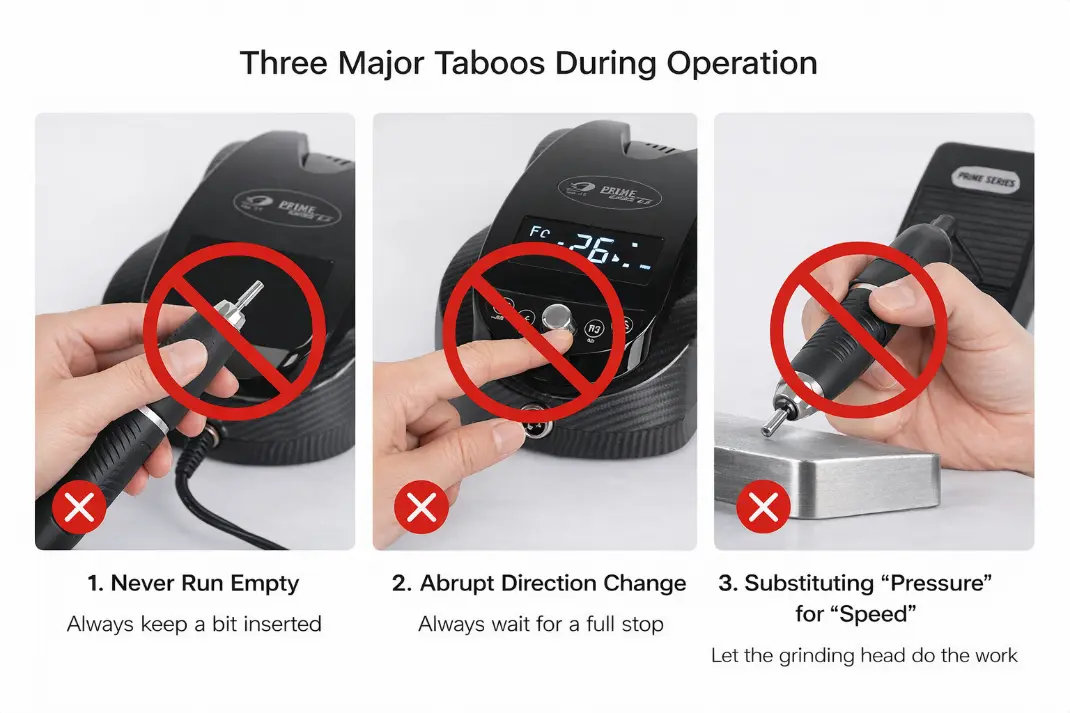
1. Never Run Empty
Running without a grinding head is dangerous. The clamping mechanism lacks support. This generates abnormally high-frequency vibrations. It leads to permanent fatigue of the internal spring.
Always keep a bit inserted. Even when idle, keep a test pin in the collet.
2. Abrupt Direction Change
Always wait for a full stop. You must wait until the motor is completely still. Forcibly switching directions creates an "instantaneous reverse current." This is the main cause of fried control box circuit boards.
3. Substituting "Pressure" for "Speed"
Let the grinding head do the work. Excessive hand pressure creates a radial load. This leads to bearing misalignment. It causes an instantaneous overload of the Micromotor. Light touch, high precision.
III. Heat Management & Core Component Maintenance
Heat is a warning sign. A hot handle means lubricant is drying out. It could also mean magnets are demagnetizing.
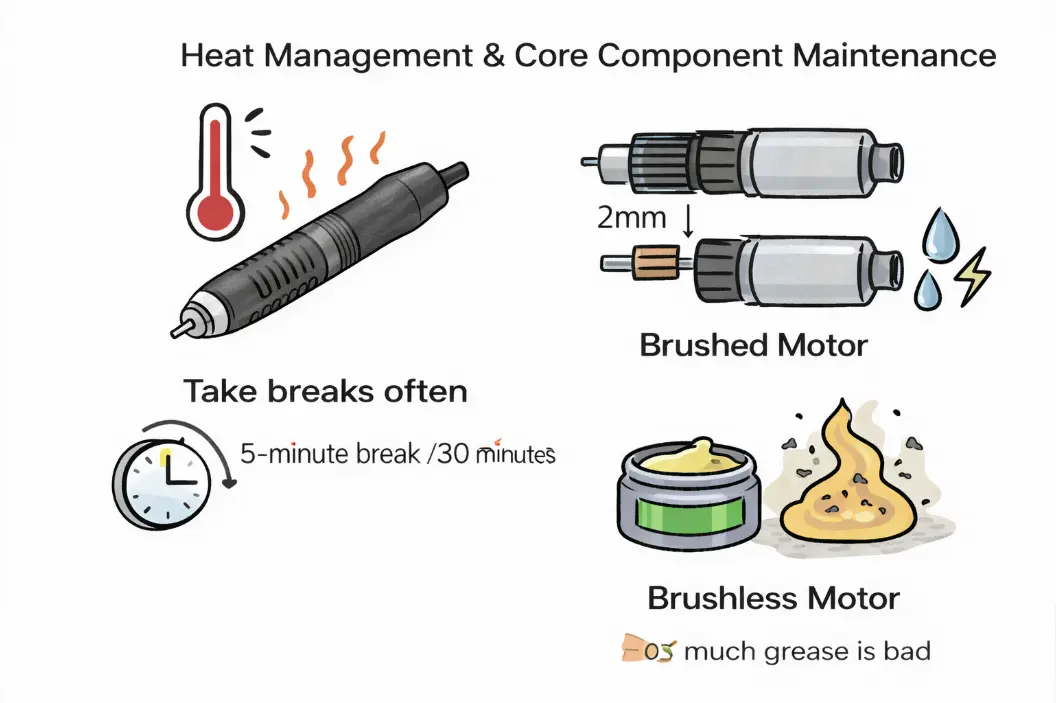
Take breaks often.
A 5-minute break every 30 minutes is mandatory. This protects the internal copper windings.
Targeted Maintenance:
- Brushed Motors: Regularly monitor the carbon brushes. Replace them when they reach 2mm. If you wait, arcing will burn out the commutator.
- Brushless Motors: These are maintenance-free but sensitive. They require low humidity and stable voltage. Avoid using them in damp environments.
- Lubrication Misconception: More is not better. Excessive grease becomes a "dust collector." It forms a thick abrasive paste inside the handle.
IV. Storage and Life Extension
How you store your tool matters. Most damage happens during downtime.
Protect the cables.
Never wrap the cable tightly around the machine. This causes internal wire fatigue. It is the top cause of intermittent power loss.
Micromotors are precision instruments. Even a 10 cm drop can ruin the bearings. Store them in a dedicated holder. Keep the unit away from chemicals like alcohol or acetone. These substances make the sealing rings brittle over time.
V. Daily Maintenance Checklist
Follow this schedule to keep your gear running smoothly.
| Frequency |
Maintenance Item |
Core Purpose |
| Daily |
Surface dusting, chuck pin cleaning |
Prevent debris intrusion; protect the clamp |
| Weekly |
Deep collet cleaning, cable inspection |
Ensure grip force; prevent shorts |
| Quarterly |
Check carbon brushes, test for noise |
Preventive replacement; avoid failure |
Conclusion
Take care of your micromotor, and it will take care of your business. Your tools are an investment, not just a purchase. High-quality equipment combined with scientific habits ensures that every piece of your work has the ultimate precision your clients expect. Don't wait for a breakdown to start a maintenance routine.
Even with perfect maintenance, your work is only as good as the hardware you start with. If you are looking to upgrade your setup or need a motor that stands up to the rigors of professional use, head over to our RHJC official. We specialize in precision-engineered Micromotors designed for the specific needs of jewelers, dental technicians, and nail artists. From ultra-smooth brushless handpieces to robust control boxes, we provide the gear that helps you work smarter. Visit us at RHJC today to find a reliable partner for your craft.